Free Communism Walking Tour – Life Behind the Iron Curtain in Budapest then and now
Starts: From 31st of March every Tuesday and Saturday from 15:30; Please check the daily tour schedule or booking calendar to confirm your date.
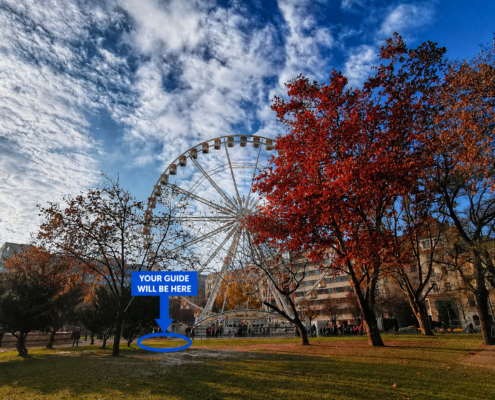
Meeting point: Erzsébet tér (Elisabeth Square) – in the park, about 10 meters from the Budapest Eye Ferris wheel, next to the Danubius fountain. Look for the “FREE TOUR” sign.
Length: 1,5 – 2 hours (~2 km)
No tour:
Meeting point: Erzsébet tér (Elisabeth Square) – in the park, about 10 meters from the Budapest Eye Ferris wheel, next to the Danubius fountain. Look for the “FREE TOUR” sign.
Length: 1,5 – 2 hours (~2 km)
No tour:
Price:Free to join – you simply tip your guide at the end if you enjoyed the tour. Most guests choose to leave a fair tip based on their budget and how much they liked the experience. (see our tipping guide here)
WHAT WE DO ON FREE COMMUNISM TOUR
During our Free Communism Tour, we focus on the major events and social realities of the communist period in Hungary. Rather than presenting only political dates, the tour explains what life actually felt like during those decades.
You will learn about the establishment of the communist regime after World War II, the role of the Soviet Union, and the key turning points that defined Hungarian history during the Cold War. One of the central topics is the 1956 Hungarian Revolution, an event that still plays an important role in the country’s collective memory.
Along the route, your guide also explains how the system affected everyday life. Topics include housing, work, censorship, propaganda, and the ways people navigated the political environment of the time.
The tour also explores what happened after communism ended. Hungary’s transition to democracy and a market economy brought major social and economic changes. We discuss how the legacy of the socialist era continues to influence politics, public debates, and even the design of the city.
By connecting past and present, this tour helps visitors understand why the communist period remains such an important reference point in modern Hungarian society.
ROUTE & MAIN SIGHTS
The tour takes place in the downtown area of Pest, around some of the main landmarks you may already know from the general city walk – but with completely different stories.
From the meeting point at Erzsébet tér we start with a short introduction to post‑war Hungary and what “Communism” actually meant here in everyday life.
From there, highlights include:
- St Stephen’s Basilica area – you hear different stories than on the Original Free Budapest Tour: how religion, churches and the state related to each other under the one‑party system.
- Liberty Square (Szabadság tér) – a key space where different monuments stand next to each other and you can see how Hungarian history is remembered, re‑interpreted and sometimes manipulated in stone.
- Secret exit of a military bunker – your guide points out an unassuming detail connected to Cold War paranoia and defence plans.
- Last standing Soviet war memorial in the city centre – a communist monument surrounded by embassies and banks, and other symbols of “Soviet friendship”, which raises questions about memory, gratitude and occupation.
- 1956 uprising locations & Bronze Bullet Memorial – we walk past areas connected to the 1956 Hungarian Revolution, including the Bronze Bullet Memorial, and talk about how this uprising is remembered today.
- Hungarian Parliament – we finish near the Parliament building, where you connect what you have heard about the communist period with today’s political system and public debates.
Please note that this is not a classical sightseeing tour: the downtown of Pest has relatively few large, visible communist‑era buildings or statues left. It is more like an accessible “street lecture” with short walks between stops, photos, anecdotes and questions, rather than a long route with many different monuments.
Most statues from the communist era were removed from the city centre after the regime change in 1989. Many of them are now displayed in the open‑air statue park known as Memento Park on the Buda side, which you can visit separately if you would like to see more original monuments from that period.
SIGHTS VISITED
GOOD TO KNOW BEFORE YOU JOIN OUR FREE COMMUNISM TOUR
Is this a free communism tour?
Yes. This is a free communism tour operating on a pay-what-you-wish basis. You decide what to contribute at the end based on your experience. Important to know that the tour starts from a minimum of 5 participants, and groups of up to 8 people need to pay a minimum 8 EUR/person fee.
What historical themes does the free communism tour cover?
The tour explores Hungary’s 20th-century history under communism, including everyday life during the socialist era, political changes, public art and monuments, and how the period shaped modern Budapest.
How long is the free communism tour?
The tour lasts approximately 1.5–2 hours, combining walking, storytelling, and key historical insights.
How large are the groups on the free communism tour?
We keep our free communism tour groups intimate. Groups never exceed 20 participants, so you get a more interactive and engaging experience with your guide.
Is booking required in advance?
Yes. Even though this is a free tour, advance booking is required to manage group sizes and ensure availability.
Is the free communism tour suitable for all ages?
Yes. Adults and teens typically enjoy it most. Sensitive historical themes are presented respectfully and in an accessible way.
Do we enter any museums or buildings on the tour?
This tour primarily takes place outdoors. Entry to museums or indoor historical sites is not included.
What happens in bad weather?
The tour runs in most weather conditions. In case of extreme weather, the route may be adjusted or rescheduled.
IF YOU WANT EVEN MORE COMMUNISM OR HISTORY
This free tour is designed as a clear and honest introduction to everyday life under Communism and its legacy in Budapest. It cannot cover every detail of politics, economics or architecture.
If you want more depth on specific topics, consider:
- Booking a fully customised private history walk, where the route and content focus more deeply on Communism, 1956 or the transition after 1989.
If you are especially interested in specific topics or want a deeper dive:
- Book a fully customised private sightseeing walk where the route, pace and content are tailored to your interests.
- Join one of our other free walks (for example the Free Budapest Tour ;
- Free Buda Castle District Tour or Free Jewish District Tour for more detailed stories about other periods and neighbourhoods of Budapest.
MEETING POINT
NOT THE TOUR YOU’RE LOOKING FOR? TRY ONE OF THESE: