Covid-19 related news

Coronavirus related news of Hungary on the 26th February 2021

As we wrote in our previous blog post, the 3rd wave of the coronavirus pandemic has hit Hungary as well, there have been more and more new cases and they have extended the Covid-19 related restrictions and border closure until at least the 15th of March. Probably they will be extended even until after this date. Our daily free tours in Budapest are still not running until further notice.

As said in our previous articles, vaccination started in Hungary, with 5 different vaccines. Right now there are about 522 000 people that got the first round and about 240 000 individuals that got the second round of the vaccination. Official news say that there could be about 2.5 million Hungarians vaccinated until this Easter out of the 10 million people living in our country.
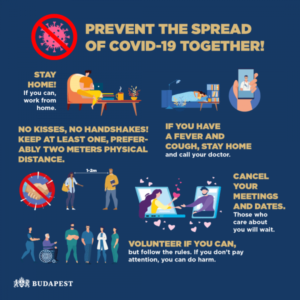
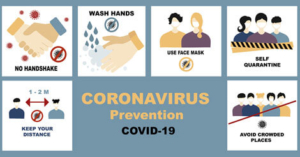
A photo by Budapest illustrating some of the precautions people should take during the covid-19 pandemic

Pic taken from : koronavirus.budapest. hu

Remembering the Victims of Communist Dictatorships on the 25th of February

The commemoration of the Day of Remembrance of the Victims of Communist Dictatorships (or the Day of Remembrance of the Victims of Communism) was adopted by the Parliament of the Republic of Hungary on 13 June 2000. According to this, Memorial Day for the Victims of Communism is held on February 25 every year in secondary education institutions.

Béla Kovács, Secretary General of the Independent Smallholders’ Party (FKGP), was arrested by the Soviet authorities on this day in 1947 for his opposition to the Communists and taken to the Soviet Union, where he spent eight years in captivity, first in the Gulag and then from September 25, 1951 in the State Security Ministry’s Central Prison, in Moscow.

The arrest and detention of the politician was the first step on the path by which the Communist Party eliminated its opponents and thus moved towards the establishment of a total one-party dictatorship. The case thus became a symbol of the disregard for democracy and freedoms that characterized the nearly 50-year rule of communism. Béla Kovács became a role model for people who were considered victims of the party state regime.
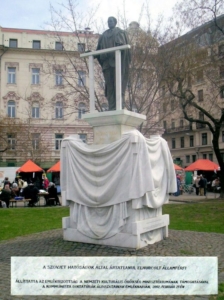
The statue of Béla Kovács, a Hungarian politician that fell victim of the Communist dictatorship

Photo of statue of Béla Kovács taken from: wikipedia

The Black Book of Communism puts the number of victims of communism worldwide at about 100 million, according to estimates and archival research. In Central and Eastern Europe, the number of victims of famine, forced labor camps or executions reaches one million, but the victims of the system are also those imprisoned, interrogated, tortured, stigmatized, persecuted for their group or religious affiliation, ie everyone deprived of the opportunity for free action and choice, mutilated physically and spiritually. You can learn more about the Communist Dictatorship in Hungary (~1948-1989) on our free Communism walking tour in Budapest, when we can be back doing tours and showing you our city & culture.

Latest News – 23rd February 2021

Latest Covid-19 related news in Hungary and at the Free Walking Tours Budapest Team

Regarding the Covid-19 related restrictions in our country, there has been one change made since our latest blog post: the parliament has extended the “emergency phase” of the country, it will be in action for another at least 90 days. We are still not running our daily free walking tours in Budapest until further notice.

Unfortunately, the 3rd wave of the coronavirus pandemic has started in Hungary recently, there have been more and more new cases and deaths reported in the last week or so. Vaccination has started too, so far Hungary uses the Pfizer/Biontech, the AstraZeneca, the Russian Sputnik V and the Chinese Sinopharm vaccines. There is about 460 000 people in our country that got the first dose of the vaccine and roughly 206 000 got the second round, too.

Covid-19 vaccination is going on all around the world

Picture from: the Official Microsoft Blog

Another piece of news regarding our walking tours in Budapest is that they are going to start the renovation of the iconic Chain bridge, the first permanent bridge on the Danube in Budapest ready in 1849. They are going to close the bridge from traffic and pedestrians, too this spring for a long time (possibly more than 1 year). Our General Free Budapest Walk and most of the travelers walking in our city used to cross this bridge on the way to the Buda side from the Pest side, all the other bridges are a bit too far for crossing in a reasonable time on one tour. This is why we are going to divide our Free Budapest Walk into 2 tours, a Pest tour and a Buda castle tour with different starting times and different meeting points. We are going to upload all the things you need to know, once we are back on track and can run our daily free walking tours in Budapest again.

Stay well and safe!


News & Carnival (Farsang) season in Hungary

Latest Covid-19 related news of Hungary

Since our last blog post there has not been any changes to restrictions in Hungary, please click on the following link to read about the latest Covid-19 news and restrictions of our country:

Carnival Season = Farsang in Hungary

Farsang in Hungarian is the name of the period from Epiphany (Vízkereszt in Hungarian, on January 6th) to Pancake day (Húshagyó kedd in our language, it is before Ash Wednesday, it is the 47th day before Easter Sunday), to the beginning of Lent. It is traditionally celebrated with happy feasts, balls, fun, folk festivals. The characteristic of the carnival season is that there is no important religious holiday associated with it in the Christian liturgical calendar, it is mostly based on folk traditions. Carnival events from pre-Christian times were prohibited in the 16th and 17th centuries, because of their wild customs mostly symbolizing lust, hedonism. In Hungary during old times, Farsang was also a period of mating and was also an important “wedding season” as it was already forbidden to hold a wedding during the Easter fast period.

The highlight of Farsang is the carnival. This period of the last three days from Carnival Sunday to Pancake day is actually a winter farewell, too. Famous carnivals (the Rio Carnival, the Venetian Carnival) are held in many cities around the world, and in Hungary the most notable event of the carnival is the ‘Busójárás’ in Mohács, a city on the southern part of Hungary, close to Serbia.

The Busójárás

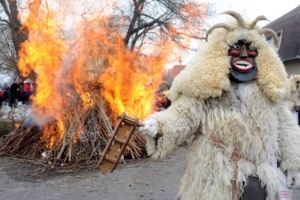
Busójárás is a celebration of the Šokci people living in the town of Mohács, Hungary, held annually at the end of the Carnival season, Farsang, ending the day before Ash Wednesday. The celebration features Busós (people wearing traditional scary masks) and it includes folk music, parades and dancing, masquerading. There are 2 reasons why they dress up in scary costumes:

  1. To scare winter away
  2. To scare the Turks away… (A big part of Hungary was under Ottoman occupation between 1541 and 1699)

The Busójárás lasts for six days and it is held usually during February. Ten thousands of people visit this event and since 2009 it has been on UNESCO’s intangible cultural heritage list.

Bonfire at the Busójárás in Mohács, held annually as part of the Carnival season

Photo: alfatours. hu

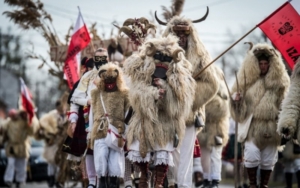
People dressed up in scary costumes during the Busójárás to scare winter and the Turks away

Photo: promenad. hu

A delicious thing we eat at Farsang

The Farsang Doughnut or Farsangi fánk as we call it in Hungarian. It is a soft yeast cake, we deep-fry it and fill it with fruit jam or eat it empty with some powdered sugar on top, yummy! Once we are back on track after the Covid-19 restrictions are eased, you can learn about more delicious Hungarian sweets on our Free walking tours in Budapest!

A few pieces of farsangi fánk (doughnut) a deep-fried yeast cake eaten at carneval season in Hungary

Photo of doughnuts: kifoztuk. hu


Latest Covid-19 related news of Hungary

Just like in each of our recent blog posts, we share the most important Covid-19 related regulations and news of our country, let’s see what’s new now:

They have extended the restrictions that have been valid for months, now they will be active until the 1st of March. These are the following, including but not limited to:

  • curfew between 8pm and 5 am, shops must close at 7pm
  • foreign citizens cannot enter Hungary (there are a few exceptions)
  • returning Hungarian citizens have to quarantine for 14 days or show 2 negative tests
  • hotels cannot have guests
  • bars, clubs, restaurants, gyms, pools, cinemas are closed
  • all gatherings are prohibited…
  • …therefore our free tours in Budapest are still not running until further notice

Tips about how to prevent the spread of the Covid-19 pandemic

Possible easing of restrictions

They have announced it today that opening up and easing the restrictions could be possible in two steps from the beginning of March and then from the beginning of April. It all depends on what happens until then with the spread of Covid-19 in Hungary. The number of new cases were decreasing in the last 1 or 2 weeks, but now it doesn’t seem to be lessening.

Covid-19 vaccination

Vaccination has started in Hungary a few weeks ago, now there are about 250 000 Hungarian people that got the first round of the vaccine and about 75 000 that got the second dose, too. There are about 10 million people living in our country, 2 million in Budapest.

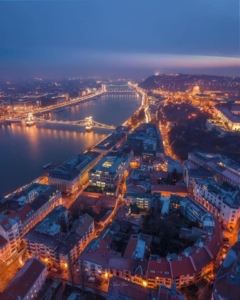
An aerial shot showing Budapest, the river Danube and the Chain bridge lit up on a winter night

Photo by tovissibence

Stay tuned, read our info on our blog, we really hope to be back with our sightseeing walking tours in Budapest as soon as possible!